Choosing the right trimmer can feel surprisingly difficult. With so many options available, one question keeps coming up: corded or cordless trimmers—which one is better?
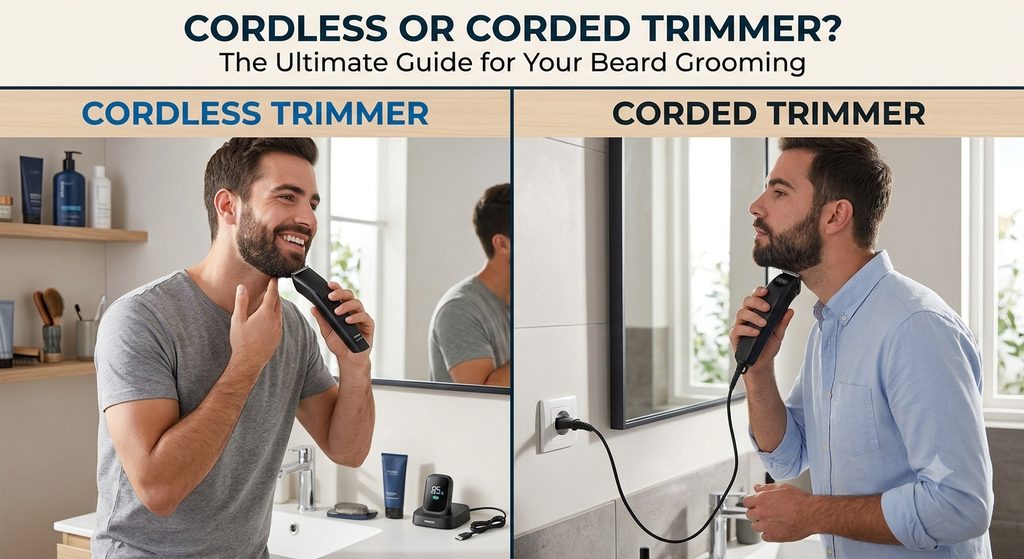
A corded trimmer gives you continuous power without worrying about battery life. On the other hand, a cordless trimmer offers freedom, portability, and much easier handling. So, which option should you choose?
The truth is that there isn’t one universal winner. The best choice depends on how, where, and how often you groom.
In this guide, we’ll compare corded or cordless trimmers across power, convenience, battery life, portability, maintenance, cost, and everyday grooming performance.
By the end, you’ll know exactly which type makes more sense for your beard, body, or general grooming routine.
Comprehensive Article Outline
Quick Answer: Corded or Cordless Trimmers?

If you want a simple answer, cordless trimmers are generally better for most home users because they’re convenient, portable, and easy to use.
However, corded models still have an important advantage: continuous power. They’re particularly useful if you groom for long periods or don’t want to deal with charging.
| Feature | Corded Trimmer | Cordless Trimmer |
|---|---|---|
| Power supply | Continuous | Battery-powered |
| Portability | Low | Excellent |
| Freedom of movement | Limited | Excellent |
| Battery concerns | None | Yes |
| Long grooming sessions | Excellent | Depends on battery |
| Travel | Less convenient | Excellent |
| Maintenance | Usually simple | Battery + blade care |
| Convenience | Moderate | Excellent |
| Best for | Long sessions | Everyday grooming |
| Overall choice | Great for power | Great for convenience |
Wahl also notes that corded models provide continuous power, while cordless models provide greater freedom of movement and portability.
Understanding Corded and Cordless Trimmers
Before deciding between corded or cordless trimmers, it’s important to understand how each type works.
A corded trimmer receives electricity directly from a wall outlet. As long as the device is connected to a suitable power source, it can continue operating. This makes corded models particularly useful for extended grooming sessions.
A cordless trimmer, meanwhile, uses a rechargeable or replaceable battery. You charge the device before use and then operate it without a cable. This makes it much easier to move around while grooming.
Neither design is automatically better.
Instead, each solves a different problem.
If uninterrupted operation is your priority, a corded model has an obvious advantage. If freedom of movement matters more, a cordless model is usually the better fit.
For everyday beard grooming, many people prefer cordless models because they can quickly grab the trimmer, shape their beard, and put it away without dealing with a cable.
How Corded Trimmers Work
Corded trimmers are designed to operate directly from mains electricity.
Their biggest advantage is simple: you don’t have to worry about battery percentage.
You can start trimming whenever you want, provided you have access to a power outlet.
This can be especially useful for users with thick facial hair who spend more time trimming or shaping their beard.
Advantages of Corded Trimmers
- Continuous power
- No charging required
- No battery degradation
- Suitable for extended grooming sessions
- Often available at competitive prices
- No need to remember to charge before use
The consistent power supply can be useful when you’re working through dense hair. A dying battery isn’t going to interrupt your grooming halfway through.
The Main Drawback
The biggest problem is the cable.
A cord can get in the way when you’re trimming around your jawline, neck, ears, or other difficult areas. You also need to remain relatively close to a power outlet.
That can make a corded trimmer less convenient for people who like grooming in different rooms or while travelling.
Wahl similarly identifies restricted movement and cable handling as key disadvantages of corded clippers.
How Cordless Trimmers Work
Cordless trimmers use an internal battery to power their motor.
Most modern rechargeable models are designed to provide enough runtime for several grooming sessions, although actual performance varies considerably between models.
The main attraction is convenience.
You don’t have to position yourself next to an electrical outlet. You can use the trimmer in the bathroom, bedroom, or while travelling, depending on the manufacturer’s instructions.
Advantages of Cordless Trimmers
- Excellent portability
- No cable getting in the way
- Easier handling
- Convenient for quick touch-ups
- Great for travel
- Better freedom of movement
For most casual users, this convenience is difficult to beat.
A cordless trimmer can be particularly useful if your grooming routine involves several areas. You can move the trimmer around your face and body without constantly adjusting a power cable.
The Battery Trade-Off
Of course, batteries aren’t perfect.
You need to remember to charge the trimmer. Battery capacity can also decline over time, and runtime varies by model and usage.
Philips recommends fully charging compatible grooming products before use and following the specific charging instructions supplied with the model.
7 Key Factors When Choosing Corded or Cordless Trimmers
1. Power and Performance
Power is often the first thing people consider when comparing corded or cordless trimmers.
A common assumption is that corded trimmers are always more powerful. That’s not necessarily true.
Modern cordless trimmers can offer strong motor performance, and some are designed specifically for demanding grooming tasks.
However, a corded device has one major advantage: its power supply doesn’t gradually run down during use.
With a cordless model, performance can depend on the battery’s remaining charge, motor design, hair density, and overall condition.
Winner: Corded
If your only priority is uninterrupted power, corded wins.
For normal home beard trimming, however, a quality cordless model can provide more than enough performance.
2. Battery Life and Charging
Battery life is one of the most important considerations when buying a cordless trimmer.
A model with excellent battery life can be extremely convenient. A model with poor runtime can become frustrating quickly.
Look for:
- Runtime per charge
- Charging time
- Quick-charge capability
- Battery indicator
- USB charging, if useful
- Whether corded operation is supported
Some trimmers offer a quick-charge feature that provides enough power for a short grooming session after only a few minutes of charging.
Wahl’s beard trimmer guidance also highlights battery runtime and quick-charge functionality as important factors when choosing a trimmer.
Winner: Corded for reliability, cordless for convenience
Corded models eliminate battery anxiety completely. Cordless models win if you value convenience and can maintain a regular charging routine.
3. Portability and Travel
This is where corded or cordless trimmers differ dramatically.
A corded trimmer needs access to an outlet. That can be inconvenient when travelling.
A cordless trimmer can simply go into your grooming kit.
For people who travel frequently, this is a major benefit.
Imagine going on a weekend trip. With a cordless trimmer, you can charge it beforehand and pack it without carrying a long cable.
Some cordless models can also be charged through USB, making them even more convenient for travel.
Winner: Cordless
For portability, there really isn’t much of a contest.
4. Beard Grooming
For beard grooming, cordless trimmers are often the more convenient choice.
Beard trimming involves working around several contours:
- Cheeks
- Jawline
- Chin
- Neck
- Sideburns
- Moustache
A cable can become annoying when you’re constantly changing angles.
Cordless operation makes shaping and detailing easier because your hand isn’t restricted by a wire.
That said, a corded trimmer can still be excellent for beard grooming if you primarily use it at home and don’t mind staying near an outlet.
Winner: Cordless
For everyday beard maintenance, cordless generally provides the better experience.
5. Body Grooming
Body grooming introduces another important consideration: reach.
When trimming areas such as the chest, stomach, arms, legs, or other body areas, freedom of movement becomes valuable.
A cordless trimmer allows you to reposition the device without dragging a cable around.
However, always check whether the particular trimmer is designed for body grooming. A beard trimmer isn’t automatically suitable for every body-grooming task.
If you want one device for both beard and body grooming, look for a multifunction grooming kit with appropriate attachments.
Winner: Cordless
For body grooming, the extra freedom generally makes cordless models more practical.
6. Precision and Control
Precision is another reason many users prefer cordless models.
When shaping a beard, small movements matter. You might need to rotate the trimmer, approach the neckline from a different angle, or switch hands.
A cable can make these movements slightly less convenient.
However, precision doesn’t depend entirely on the power source.
Blade quality, guard design, motor performance, ergonomics, and weight can have an even bigger impact.
Therefore, don’t buy a cordless trimmer simply because it’s cordless. Look at the complete design.
Winner: Cordless for handling
Cordless models generally offer greater freedom, but overall precision depends on the individual trimmer.
7. Price and Long-Term Value
Price is where the answer becomes less straightforward.
Basic corded trimmers can sometimes be affordable because they don’t require a rechargeable battery system.
Cordless models may cost more because they include batteries, charging systems, and additional electronics.
However, the cheapest option isn’t necessarily the best value.
Consider:
- Purchase price
- Battery quality
- Blade durability
- Replacement parts
- Warranty
- Attachments
- Charging accessories
- Expected lifespan
A slightly more expensive cordless trimmer may provide better everyday value if you use it regularly.
Winner: Depends on the model
For pure upfront cost, corded may have an advantage. For convenience and versatility, cordless can offer stronger overall value.
Corded vs Cordless Trimmers: Pros and Cons
Corded Trimmer Pros
- Continuous operation
- No battery charging
- Consistent power supply
- Suitable for long sessions
- No rechargeable battery to degrade
- Often simple to maintain
Corded Trimmer Cons
- Cable restricts movement
- Less convenient for travel
- Requires access to an outlet
- Cable can interfere with detailed grooming
- Less flexible for body grooming
Cordless Trimmer Pros
- Excellent portability
- Easy to handle
- No cable restrictions
- Convenient for quick grooming
- Excellent for travel
- Useful for beard and body grooming
Cordless Trimmer Cons
- Requires charging
- Battery eventually loses capacity
- Runtime varies by model
- Performance can be affected by low battery
- Charging accessories can be misplaced
When comparing corded or cordless trimmers, the key is to decide which disadvantages you’re more willing to accept.
Corded vs Cordless Trimmers for Home Use
For most home users, cordless is the easier recommendation.
Why?
Because home grooming is usually short and occasional.
You might spend 5 to 20 minutes trimming your beard. In that situation, the freedom of a cordless trimmer is usually more valuable than unlimited runtime.
You can charge the trimmer after use and keep it ready for the next session.
However, if you have a large family using the same device or you regularly perform long grooming sessions, corded operation can make more sense.
Corded vs Cordless Trimmers for Professional Use
Professional users have different requirements.
Barbers and stylists may use trimmers repeatedly throughout the day. In that environment, reliability, runtime, heat management, blade performance, and ergonomics become critical.
That’s why professionals may use both types.
A corded model can provide continuous power during demanding sessions, while a cordless model can make detailing and finishing easier.
Wahl states that professional users may benefit from having both corded and cordless equipment available for different situations.
So, if you’re a professional, don’t necessarily think of corded and cordless as competitors.
They can actually complement each other.
Corded or Cordless Trimmers for Travel
If you’re travelling frequently, cordless is the obvious choice.
A compact cordless trimmer can fit easily into a toiletry bag or grooming kit.
Before travelling, check:
- Battery level
- Charging cable
- Travel lock
- Voltage requirements
- Attachments
- Protective cap
If you’re flying, also follow the airline’s current rules regarding rechargeable electronic devices and batteries.
For short trips, a fully charged cordless trimmer may be all you need.
Maintenance Tips for Better Trimmer Performance
Regardless of whether you choose corded or cordless trimmers, maintenance matters.
A poorly maintained trimmer can become less efficient, noisier, and harder to use.
Clean After Use
Remove hair from the blades and around the cutting head.
Some models are washable, while others should only be cleaned with a brush.
Always follow the manufacturer’s instructions.
Philips recommends cleaning grooming devices after use and warns that washable does not always mean the entire device can be submerged.
Oil the Blades When Required
Some trimmers require blade oil.
Proper lubrication can help the cutting system operate smoothly and reduce unnecessary friction.
Store It Properly
Keep your trimmer somewhere dry and protected.
Don’t leave it buried under other bathroom products where the blade or charging cable can become damaged.
Look After the Battery
For cordless models, use the charging method recommended by the manufacturer.
Don’t assume every trimmer follows the same charging requirements.
Should You Buy a Corded, Cordless, or Cord/Cordless Trimmer?
There’s actually a third option worth considering: cord/cordless trimmers.
These models can operate from the battery but may also be used while connected to power, depending on the design.
This can give you the best of both worlds.
You get cordless convenience for normal grooming and wired operation when the battery is low.
Some Wahl models, for example, are designed to provide both corded and cordless operation.
If you’re unsure which category suits you, a hybrid model can be a smart compromise.
How to Choose the Right Trimmer for Your Needs
Before buying, ask yourself these questions.
Do You Mostly Trim Your Beard?
Choose cordless if you value easy handling and quick grooming.
Do You Trim for Long Periods?
Consider corded or cord/cordless models.
Do You Travel Often?
Cordless is usually the better option.
Do You Groom Your Body?
Cordless provides useful freedom of movement.
Do You Forget to Charge Devices?
Corded may save you some frustration.
Do You Want One Trimmer for Everything?
Look for a versatile cordless multigroomer with suitable attachments.
Do You Want Maximum Convenience?
Cordless is generally the winner.
A Simple Buying Checklist
Before purchasing corded or cordless trimmers, check these seven things:
- Motor performance – Make sure it can handle your hair type.
- Blade quality – Look for durable, skin-friendly cutting systems.
- Battery runtime – Important for cordless models.
- Charging time – Faster charging is useful for busy routines.
- Attachments – Check whether the included guards match your needs.
- Cleaning requirements – Understand whether the trimmer is washable.
- Warranty and replacement parts – These can affect long-term value.
Don’t get distracted by flashy features.
A trimmer doesn’t need dozens of accessories to be good. It needs to perform its main job reliably.
For additional guidance, Wahl’s beard trimmer buying guide provides useful information on battery life, attachments, and choosing a trimmer for different grooming needs.
Frequently Asked Questions
1. Are corded or cordless trimmers better?
For most home users, cordless trimmers are more convenient because they offer freedom of movement and portability. Corded models are better when continuous power is the priority.
2. Do cordless trimmers have less power than corded trimmers?
Not necessarily. Modern cordless trimmers can deliver strong performance. However, corded models don’t have to rely on remaining battery capacity, so their power supply remains continuous.
3. Which is better for beard grooming?
Cordless trimmers are generally better for beard grooming because they’re easier to move around the cheeks, chin, jawline, and neck.
4. Are corded trimmers better for thick beards?
They can be useful because they provide uninterrupted power. However, motor strength and blade design matter more than simply choosing corded operation.
5. Which trimmer is better for travel?
Cordless is the better choice for travel. You don’t need to stay near an electrical outlet, and the device is easier to pack.
6. Do cordless trimmer batteries wear out?
Yes. Rechargeable batteries naturally lose capacity over time. How quickly this happens depends on the battery type, usage, charging habits, and product design.
7. Can a cordless trimmer be used while charging?
It depends on the model. Some cord/cordless trimmers support wired operation, while certain waterproof grooming devices may specifically require cordless operation. Always check the manufacturer’s instructions.
8. Are corded trimmers cheaper?
They can be cheaper at the entry level because they don’t require a rechargeable battery system. However, pricing varies widely by brand, motor, blades, and included features.
9. Which is better for body grooming?
Cordless models are usually more convenient because body grooming requires more movement and different angles.
10. Should I buy a corded or cordless trimmer for everyday use?
For most people, cordless is the better everyday choice. It’s quick, convenient, portable, and easier to handle.
Final Verdict: Corded or Cordless Trimmers — Which One Is Better?
So, corded or cordless trimmers—which one is better?
For the majority of everyday users, cordless trimmers are the better overall choice.
They’re easier to handle, more portable, and more convenient for beard and body grooming. You can use them without being tied to a wall outlet, which makes everyday grooming much less frustrating.
However, corded trimmers still make sense if you prioritize continuous power, regularly have long grooming sessions, or simply don’t want to worry about charging.
And if you’re stuck between the two, consider a cord/cordless model. It can provide the freedom of cordless operation while giving you the option of wired power when needed.
Ultimately, don’t choose based on the label alone. Think about your grooming routine.
If convenience, portability, and freedom matter most, go cordless.
If uninterrupted operation and consistent power are your priorities, go corded.
Either way, the best trimmer is the one that fits your actual grooming habits—not necessarily the one with the longest feature list or the highest price tag.
4 Comments
Comments are closed.